It often seems to me the hardest thing to do is forgive. Generally as humans, we don't want to forgive those who have wronged us, even for the most minor of offenses.
Something that you've probably heard from me before, forgiveness is a grace. It's not something that is natural to the vast majority of our beings.
It's a lot easier to hold grudges against people than it is to forgive them. Yes, we pray during the Liturgy, forgive us our trespasses as we forgive those who trespass against us. (from the Our Father) and we do know Our Lord's words of drop anything against one's brother before coming to the altar.
Let us extend the mercy that God shows to us, unto others...so that we might set aside all earthly cares.
Showing posts with label reflections. Show all posts
Showing posts with label reflections. Show all posts
31 July 2016

21 February 2016
Reflection on the Troparia and Kontakia of the 3rd Sunday of Lent
The Troparia for This coming Sunday are:
You have destroyed Death by your cross, you opened paradise to the thief, The sorrow of the myrrh bearers you turned to joy. You commanded your apostles to proclaim: Christ our God, you have risen, granting great mercy to the world.
Save your people O Lord, and bless your inheritance. Grant victory to your Church over evil and protect your people by your Cross
The Kontokian for this coming Sunday is as follows:
No longer does the flaming sword guard over the ages of Eden, for the tree of the cross has come to quench it wondrously. The sting of death and the victory of Hades have been driven out. For you, O my Saviour, stood and called out to those in Hades, Enter again into paradise.
On this the Third Sunday of Lent, we venerate the Holy Cross,
In the 1st Troparia, which is the Troparia of the resurrection, we see Jesus remembering the good thief on the cross.
We recall the words of the good thief in the prayer before Holy Communion, "Remember me, O Lord when you come into your Kingdom." Why do we pray these words? We beg for the mercy of God (as we have been throughout the Liturgy)....These are not just empty words on a page, they are quite significant. We beg for God's mercy to not eat and drink our own condemnation in the reception of Holy Communion. We pray for the forgiveness of all of our sins, God is good and loves us all, and all things are possible through the Holy Trinity.
To proclaim: Christ is Risen, granting great mercy to the world. As St Paul alludes to, the Faith is in in vain if the resurrection did not happen. Great mercy, the latin word misericordiae, literally means o have a place in the heart....
My Bishop Gerald puts it this way "...mercy has a much deeper, more profound meaning. I did not simply mean to feel sorry for a person. The word "mercy" mean to have the ability to get inside the "body" of a person so that you can see things as he/she sees them. It meant to possess the ability o think with their minds and to feel with their feelings."
Our Lord did exactly this by taking flesh, being born of a woman (cf Eph 4, 4-6, Phil 2, 1-12). Taking on human nature in all things but sin. Our God is very personal and not someone that is far or abstract as some would like to say. For some this can be quite a challenge, how could God be so personable? I is definitely a great mystery and something we could dwell upon forever.
It sometimes seems that evil is going to conquer the Church. Whether it's ridiculous statements by *insert clergy member here* or some type of scandal, we know our God who loves us all, keeps His promises, the gates of hell will not prevail against the Church. (Mt 16, 19), we pray the grace of Our Lord guide the Church through the various storms that attack the Church.
After the ancestral sin of our parents Adam and Eve, the tree of Life, the Cross restores what was lost. Death has been trampled by Death, by His grace are we able to enter eternal life. Those that died before Christ were called on his decent into Hades.
Today in addition to the Exaltation of the Holy Cross, we in the Byzantine church chant "We bow to your Cross, O Lord, and we glorify, your Holy Resurrection. In place of the Holy God, Holy Mighty, Holy and Immortal. 3 times of course.
It is through the Cross that we are able to have Life after death, let us focus upon the mystery of the cross, and do our best, so that Our Lord will indeed, remember us when we come into His Kingdom.
You have destroyed Death by your cross, you opened paradise to the thief, The sorrow of the myrrh bearers you turned to joy. You commanded your apostles to proclaim: Christ our God, you have risen, granting great mercy to the world.
Save your people O Lord, and bless your inheritance. Grant victory to your Church over evil and protect your people by your Cross
The Kontokian for this coming Sunday is as follows:
No longer does the flaming sword guard over the ages of Eden, for the tree of the cross has come to quench it wondrously. The sting of death and the victory of Hades have been driven out. For you, O my Saviour, stood and called out to those in Hades, Enter again into paradise.
On this the Third Sunday of Lent, we venerate the Holy Cross,
In the 1st Troparia, which is the Troparia of the resurrection, we see Jesus remembering the good thief on the cross.
We recall the words of the good thief in the prayer before Holy Communion, "Remember me, O Lord when you come into your Kingdom." Why do we pray these words? We beg for the mercy of God (as we have been throughout the Liturgy)....These are not just empty words on a page, they are quite significant. We beg for God's mercy to not eat and drink our own condemnation in the reception of Holy Communion. We pray for the forgiveness of all of our sins, God is good and loves us all, and all things are possible through the Holy Trinity.
To proclaim: Christ is Risen, granting great mercy to the world. As St Paul alludes to, the Faith is in in vain if the resurrection did not happen. Great mercy, the latin word misericordiae, literally means o have a place in the heart....
My Bishop Gerald puts it this way "...mercy has a much deeper, more profound meaning. I did not simply mean to feel sorry for a person. The word "mercy" mean to have the ability to get inside the "body" of a person so that you can see things as he/she sees them. It meant to possess the ability o think with their minds and to feel with their feelings."
Our Lord did exactly this by taking flesh, being born of a woman (cf Eph 4, 4-6, Phil 2, 1-12). Taking on human nature in all things but sin. Our God is very personal and not someone that is far or abstract as some would like to say. For some this can be quite a challenge, how could God be so personable? I is definitely a great mystery and something we could dwell upon forever.
It sometimes seems that evil is going to conquer the Church. Whether it's ridiculous statements by *insert clergy member here* or some type of scandal, we know our God who loves us all, keeps His promises, the gates of hell will not prevail against the Church. (Mt 16, 19), we pray the grace of Our Lord guide the Church through the various storms that attack the Church.
After the ancestral sin of our parents Adam and Eve, the tree of Life, the Cross restores what was lost. Death has been trampled by Death, by His grace are we able to enter eternal life. Those that died before Christ were called on his decent into Hades.
Today in addition to the Exaltation of the Holy Cross, we in the Byzantine church chant "We bow to your Cross, O Lord, and we glorify, your Holy Resurrection. In place of the Holy God, Holy Mighty, Holy and Immortal. 3 times of course.
It is through the Cross that we are able to have Life after death, let us focus upon the mystery of the cross, and do our best, so that Our Lord will indeed, remember us when we come into His Kingdom.
14 January 2016
Papolatry and Politization
Lately, it's been so overwhelming with all of these reports about the pope doing x, and the pope doing y, it seems to me a perfect time to zip both sides up.
The pope is certainly not God, we love him, we respect him, but not necessarily every word that comes from his mouth is Gospel, or is necessarily a good idea.
It seems to me there's an extremist point of view with the pope:
a. 100% of what he says is orthodox
b. 0% of what he says is orthodox
Where the truth is that there's no set percentage in between...the charism of infalibility only applies when the pope either via ordinary means or extra-ordinary means, re-states what the Church has already taught. (cf. Vatican I). Basically, the pope has zero power to invent dogma (has to already be taught through the centuries, via the Liturgy, Scripture, Tradition)...or in short, yes, a pope can indeed be quite heretical.
Sure, a pope can lose his office, if he does in his official capacity as pope attempt to require us faithful to believe a heresy, but it is NOT up to us as private lay people to be the judge, jury and executioner of this action. (Hence as tiring as it is sometimes to hear this pope is from time to time, no we have zero authority to depose him)
Yes, we can (and should) point out errors when they do occur, but it is our job to inform, not convict anyone. Hence why we can say something such as that is heretical, but we can't say if a person is a heretic (formally) for we are lower than the clergy...At most we can say a person is a material heretic, we can't assume there is knowledge on the end of a person.
Quite frankly, we need to keep our eyes focused towards heaven, and stop stressing over everything that comes out from Rome. Doesn't mean we need to be ignorant of what is happening, but before we go transforming the world, we need to start on the interior.
The pope is certainly not God, we love him, we respect him, but not necessarily every word that comes from his mouth is Gospel, or is necessarily a good idea.
It seems to me there's an extremist point of view with the pope:
a. 100% of what he says is orthodox
b. 0% of what he says is orthodox
Where the truth is that there's no set percentage in between...the charism of infalibility only applies when the pope either via ordinary means or extra-ordinary means, re-states what the Church has already taught. (cf. Vatican I). Basically, the pope has zero power to invent dogma (has to already be taught through the centuries, via the Liturgy, Scripture, Tradition)...or in short, yes, a pope can indeed be quite heretical.
Sure, a pope can lose his office, if he does in his official capacity as pope attempt to require us faithful to believe a heresy, but it is NOT up to us as private lay people to be the judge, jury and executioner of this action. (Hence as tiring as it is sometimes to hear this pope is from time to time, no we have zero authority to depose him)
Yes, we can (and should) point out errors when they do occur, but it is our job to inform, not convict anyone. Hence why we can say something such as that is heretical, but we can't say if a person is a heretic (formally) for we are lower than the clergy...At most we can say a person is a material heretic, we can't assume there is knowledge on the end of a person.
Quite frankly, we need to keep our eyes focused towards heaven, and stop stressing over everything that comes out from Rome. Doesn't mean we need to be ignorant of what is happening, but before we go transforming the world, we need to start on the interior.
Some thoughts on sin/confession
In the Divine Liturgy, we pray the following:
"O Lord, I also believe and profess that this, which I am about to receive, is truly your most precious body and your life-giving blood, which I pray, make me worthy to receive for the remission of all my sins and for life everlasting. Amen
O God, be merciful to me a sinner
O God, cleanse me of my sins and have mercy on me
O Lord, forgive me for I have sinned without number."
Something I find a bit fascinating is that we pray for the remission of all of our sins...this may seem rather strange for those on the outside looking in, or those that are not familiar at all...typically more people are familiar with the western terminology and mindset towards sin, which goes a little something like this:
A person must be in the "state of grace" to receive Holy Communion, and one can determine this via:
Mortal sin: sin that leads directly to the cutting off of our relationship with God...(must go directly to confession, or make a perfect act of contrition with the resolve of going to confession asap)
Venial sin: sin of a lesser degree, wounds, but not completely cuts off our relationship with God. (forgiven during the penitential act, and by receiving Communion)
Then for a sin to be mortal there are 3 conditions
a. Grave matter
b. full knowledge
c. the intention to sin to do it.
All wonderful and good mind you, absolutely nothing against what has been presented...however, for those that tend towards scrupulosity, and those that tend to be a bit OCD about their sinful lives, perhaps this approach wouldn't necessarily be quite helpful...and perhaps might make one go crazy over things when perhaps they should not do so...
As the old saying goes, life in the Church is not meant to drive one insane (it really isn't, I know it might be hard to believe at times...especially in these times)
In the Eastern world, confession is more or less seen as move on and strive to do better. Cooperate with the graces given and strive to "sin no more", rather than atonement for what we've done in the past...and perhaps one of these days I'll write a more detailed write up on the Eastern thoughts on sin...but today's not that day.
In the Eastern world, sin is more or less seen as falling short, or not cooperating with those graces that are received. No need to define exactly which is which, simply falling short, and we need to ry and do better.
At least in my own experience for me it's been much easier and freeing to live the Eastern spirituality towards confession and sin. I find it much easier when I do need to go to confession, to say what needs to be said. Perhaps it's because my world is so defined being a mathematician and a physicist, that spiritually, so to speak, a break from what is the normal course of thought should be done.
So yes, sometimes it is better to do an examination once a month, rather than a hurried confession before Divine Liturgy....this is not to say not to go to confession, of course one should. But one should not be scrupulous, or going mad stressing over every little thing either.
"O Lord, I also believe and profess that this, which I am about to receive, is truly your most precious body and your life-giving blood, which I pray, make me worthy to receive for the remission of all my sins and for life everlasting. Amen
O God, be merciful to me a sinner
O God, cleanse me of my sins and have mercy on me
O Lord, forgive me for I have sinned without number."
Something I find a bit fascinating is that we pray for the remission of all of our sins...this may seem rather strange for those on the outside looking in, or those that are not familiar at all...typically more people are familiar with the western terminology and mindset towards sin, which goes a little something like this:
A person must be in the "state of grace" to receive Holy Communion, and one can determine this via:
Mortal sin: sin that leads directly to the cutting off of our relationship with God...(must go directly to confession, or make a perfect act of contrition with the resolve of going to confession asap)
Venial sin: sin of a lesser degree, wounds, but not completely cuts off our relationship with God. (forgiven during the penitential act, and by receiving Communion)
Then for a sin to be mortal there are 3 conditions
a. Grave matter
b. full knowledge
c. the intention to sin to do it.
All wonderful and good mind you, absolutely nothing against what has been presented...however, for those that tend towards scrupulosity, and those that tend to be a bit OCD about their sinful lives, perhaps this approach wouldn't necessarily be quite helpful...and perhaps might make one go crazy over things when perhaps they should not do so...
As the old saying goes, life in the Church is not meant to drive one insane (it really isn't, I know it might be hard to believe at times...especially in these times)
In the Eastern world, confession is more or less seen as move on and strive to do better. Cooperate with the graces given and strive to "sin no more", rather than atonement for what we've done in the past...and perhaps one of these days I'll write a more detailed write up on the Eastern thoughts on sin...but today's not that day.
In the Eastern world, sin is more or less seen as falling short, or not cooperating with those graces that are received. No need to define exactly which is which, simply falling short, and we need to ry and do better.
At least in my own experience for me it's been much easier and freeing to live the Eastern spirituality towards confession and sin. I find it much easier when I do need to go to confession, to say what needs to be said. Perhaps it's because my world is so defined being a mathematician and a physicist, that spiritually, so to speak, a break from what is the normal course of thought should be done.
So yes, sometimes it is better to do an examination once a month, rather than a hurried confession before Divine Liturgy....this is not to say not to go to confession, of course one should. But one should not be scrupulous, or going mad stressing over every little thing either.
15 January 2015
Back from retreat...and so I'll try to get some thoughts out.
Fact of the matter is that I haven't been home, and have not had a chance to type out my handwritten notes from the retreat that I went on.
Before I begin though, if you can pray for a priest named Fr. Matthew, I'd (and he'd) appreciate it.
The theme of the retreat was the Family: The Martins, for those of you that know me, know I have a particular affection for St. Therese (and St Tatyana, whose feast day it was yesterday)...
a. There are certain sins that are deep symptoms of loneliness and regret. One should avoid these things, remember that in God is strength, and not other people.
b. It is important to have a disposition of silence so that God can speak. This is the spirituality of Carmel.
c. To conquer the past, one can't do it on their own. Some anger with God is healthy, but can' dwell or be a perpetual pity fest.
More to come....
Before I begin though, if you can pray for a priest named Fr. Matthew, I'd (and he'd) appreciate it.
The theme of the retreat was the Family: The Martins, for those of you that know me, know I have a particular affection for St. Therese (and St Tatyana, whose feast day it was yesterday)...
a. There are certain sins that are deep symptoms of loneliness and regret. One should avoid these things, remember that in God is strength, and not other people.
b. It is important to have a disposition of silence so that God can speak. This is the spirituality of Carmel.
c. To conquer the past, one can't do it on their own. Some anger with God is healthy, but can' dwell or be a perpetual pity fest.
More to come....
28 December 2014
Some thoughts on tomorrow's readings.
Tomorrow in Byzantium (though I'll be at Roman Church tomorrow due to the fact that I have no car) we will celebrate the Sunday after the Nativity...the readings during DL are Gal 1, 11-19, and Matt 2, 13-23
In the Name of the Father, and of the Son, and of the Holy Spirit Amen.
Pride is the sin where exalt ourselves above God. It's the I can do anything without God attitude...It also takes the form when we think we know better than God.
In the 11th and 12th verses we read "Now I want you to know, brothers, that the gospel preached by me is not of human origin. For I did not receive it from a human being, nor was I taught it, but it came through a revelation of Jesus Christ."
Has it not been in the recent news about the Synod about those that are seeking to change the teachings of Christ Jesus for their own agendas. This is pride plain and simple to contradict the dogmas of Christ as given to us through the Holy Catholic Church.
Last time I checked we are not smarter than God, for it is God who gave us the faculties of reason to begin with. It's an exercise in futility to try and outsmart God. He knows what we need to be joyful in Him, why do we attempt to make things so complicated?
When one cooperates with the graces given to them, one is able to do great things. S Paul goes from a persecutor of the Church to one of her greatest defenders. As he's briefly telling of us of what he used to do to the Church, recall from a few days ago the Martyrdom of St Stephen...killed by Saul.
In today's Gospel, we hear of the plight to Egypt, the Holy Innocents, and the return to Egypt.
Perhaps there's a use of a sarcastic element when we read "Go and search diligently for the child. When you have found him, bring me word, that I too may go and do him homage."...Herod had zero intentions of paying homage to Our Lord and Saviour Jesus Christ as we'l find ou later in the massacre of the Holy Innocents (Today who's feast day in the Roman Church would be celebrated today) In the Byzantine tradition the number killed was 14 000. There's no exact number, for it wasn't revealed.
Such a tragedy that we as a society commit another form of pride through abortion. The deliberate killing of a child. It is such a poverty that children must die so that we may live as we so choose.
The virtue that kills pride is humility. It is first the recognition that our gifts, whatever ones we do have come from God, and not ourselves. Our children, our intelligence, our various talents are no of our own doing. We must recognize this. It is then the attitude of receiving or accepting what is given. . It is hard to accept compliments, or situations that oppose our own nature...yet we must do so. It is not humility to impose ourselves on situations where that is not called for.
Let us pray for the gift of humility, and more importantly practice humility to conquer our pride.
Christ is Born, Glorify Him
In the Name of the Father, and of the Son, and of the Holy Spirit, Amen.
In the Name of the Father, and of the Son, and of the Holy Spirit Amen.
Pride is the sin where exalt ourselves above God. It's the I can do anything without God attitude...It also takes the form when we think we know better than God.
In the 11th and 12th verses we read "Now I want you to know, brothers, that the gospel preached by me is not of human origin. For I did not receive it from a human being, nor was I taught it, but it came through a revelation of Jesus Christ."
Has it not been in the recent news about the Synod about those that are seeking to change the teachings of Christ Jesus for their own agendas. This is pride plain and simple to contradict the dogmas of Christ as given to us through the Holy Catholic Church.
Last time I checked we are not smarter than God, for it is God who gave us the faculties of reason to begin with. It's an exercise in futility to try and outsmart God. He knows what we need to be joyful in Him, why do we attempt to make things so complicated?
When one cooperates with the graces given to them, one is able to do great things. S Paul goes from a persecutor of the Church to one of her greatest defenders. As he's briefly telling of us of what he used to do to the Church, recall from a few days ago the Martyrdom of St Stephen...killed by Saul.
In today's Gospel, we hear of the plight to Egypt, the Holy Innocents, and the return to Egypt.
Perhaps there's a use of a sarcastic element when we read "Go and search diligently for the child. When you have found him, bring me word, that I too may go and do him homage."...Herod had zero intentions of paying homage to Our Lord and Saviour Jesus Christ as we'l find ou later in the massacre of the Holy Innocents (Today who's feast day in the Roman Church would be celebrated today) In the Byzantine tradition the number killed was 14 000. There's no exact number, for it wasn't revealed.
Such a tragedy that we as a society commit another form of pride through abortion. The deliberate killing of a child. It is such a poverty that children must die so that we may live as we so choose.
The virtue that kills pride is humility. It is first the recognition that our gifts, whatever ones we do have come from God, and not ourselves. Our children, our intelligence, our various talents are no of our own doing. We must recognize this. It is then the attitude of receiving or accepting what is given. . It is hard to accept compliments, or situations that oppose our own nature...yet we must do so. It is not humility to impose ourselves on situations where that is not called for.
Let us pray for the gift of humility, and more importantly practice humility to conquer our pride.
Christ is Born, Glorify Him
In the Name of the Father, and of the Son, and of the Holy Spirit, Amen.
28 September 2014
Why do we implore Mercy?
In the glossary of the CCC 2nd Edition, there is given a definition of mercy, which is as follows:
The loving kindness, compassion, or forbearance shown to one who offends.
In the Byzantine Church, the priest says "Let us pray to the Lord" (Господу помолимся) and we reply "Lord have mercy" (Господи помилуй, Κυριε ελεισον)
I find it rather interesting during the present pontificate we're speaking of Mercy. But in order for us to speak of it, we need to know what in the world that we're talking about, and whether an action in of itself is merciful.
The one thing I'd like to add to the definition of mercy that I've provided you is that mercy does not always imply kindness. In some situations we have to justly "be mean" in order to be merciful...
It is rather merciful to not allow a person to commit a mortal sin when receiving Communion in particular when this situation has gone public for everyone to know, and to receive would cause scandal amongst the Faithful. This is why the Church has CIC 915, not as a weapon, but rather as the greatest mercy she can provide to the Faithful, to help them not drown themselves further into the abyss. The same goes for the public knowledge of those that have re-married (Separation or Divorce does not exclude one from Communion per se)
At the same token it is merciful to allow people to present their case when they've been accused of a wrong doing. So of course it is positive as well. But Mercy can never be at the exemption of Truth.
Lord have mercy, we beg of Him to have compassion for our weakness...in His compassion for His creation, he gives us free will to serve Him...and so often we fail, and yet He still loves us...and in His mercy allows us another day.
Let us thank the Lord for His mercy, for without it, we're screwed.
Pax Vobis
The loving kindness, compassion, or forbearance shown to one who offends.
In the Byzantine Church, the priest says "Let us pray to the Lord" (Господу помолимся) and we reply "Lord have mercy" (Господи помилуй, Κυριε ελεισον)
I find it rather interesting during the present pontificate we're speaking of Mercy. But in order for us to speak of it, we need to know what in the world that we're talking about, and whether an action in of itself is merciful.
The one thing I'd like to add to the definition of mercy that I've provided you is that mercy does not always imply kindness. In some situations we have to justly "be mean" in order to be merciful...
It is rather merciful to not allow a person to commit a mortal sin when receiving Communion in particular when this situation has gone public for everyone to know, and to receive would cause scandal amongst the Faithful. This is why the Church has CIC 915, not as a weapon, but rather as the greatest mercy she can provide to the Faithful, to help them not drown themselves further into the abyss. The same goes for the public knowledge of those that have re-married (Separation or Divorce does not exclude one from Communion per se)
At the same token it is merciful to allow people to present their case when they've been accused of a wrong doing. So of course it is positive as well. But Mercy can never be at the exemption of Truth.
Lord have mercy, we beg of Him to have compassion for our weakness...in His compassion for His creation, he gives us free will to serve Him...and so often we fail, and yet He still loves us...and in His mercy allows us another day.
Let us thank the Lord for His mercy, for without it, we're screwed.
Pax Vobis
13 August 2014
Let's talk about some sensitive topics...
a. Choices versus the capacity to make these choices.

Ultimately the actions that we make are a result of free will. We're not puppets or minions, we have the ability to choose. Now, that said it's an entirely different situation our capacity to make these choices. There are various traumas that happen which result in the lessening of free will. (Hence why it is possible to become addicted to something)....this can be applied to any situation and does not require one to be "mentally ill" for this to happen.
We can use this in the positive sense...For example, if I post a picture of a kitten here, it is likely your heart will be warmed and you'll seek to actually read this post in full...
In this rather cute example, using the image of baby animals is totally intended to get the "awwwws" out. If I repeatedly give pictures of cute animals, our minds may very well start to go, awww, I need one of these cute animals....(they do say that Cat stands for: Cute Adorable Thing)...some might call this positive brainwashing. ;)...Now obviously this example isn't perfect because there are those that hate animals. (Which I'd argue there's something wrong with them, but this is not the point)
In the negative we can take for example when someone gets hurt by another person. Those that have a certain temperament will more than likely hold on to this pain much longer and more than likely make their own lives with a much bigger cross by being the perpetual reminder of a particular pain towards a person, and likely shut out people who seek to heal that pain...
One may ask, why do I bring this topic up? I know all of us have recently heard about the death of Robin Williams (May his memory be eternal)...and there are many people approaching the problem of suicide....One such a post is here, I suggest that everyone actually read the post before jumping to conclusions based upon the title of the post.
There are some that say that all people who commit suicide are in hell and there is no hope for them at all. We most certainly know from our theology that a mortal sin has to have 3 conditions: 1. grave matter 2. sufficient knowledge and 3. full consent of the will and ALL three must be met to be a mortal sin. We can speak of something being objectively sinful most certainly, but we do not know the state of the person's mind or soul when making certain decisions, so as an act of mercy we should indeed pray for them.
The act of killing oneself is most certainly a choice...One can choose to do it, or one can choose to not do it. Now that said, the capacity to make that choice is an entirely different issue. Now I didn't major in psychology (despite physics sounding similar) but I'm pretty sure something has to be off mentally, for someone to make that decision to kill oneself. I imagine it'd be rare for a person to have full conscious access to their faculties to do that. One can argue there were different things that got to Mr. Williams to lead him towards this state, while a choice, it was made under duress or stress so it can't be said to have full consent of the will so to speak. So to condemn Mr. Williams I think would be the wrong thing to do.
Mental illness is indeed a real thing, and something that people shouldn't joke about at all. And while I don't think all things are mental illnesses, I do think it's something that needs to be explored more to really understand what's going on.
I can speak to a bit of a personal experience. I lost an aunt to suicide many years ago. I was a wee young person at the time. (The first of many deaths that I'd experience in my teenage years). I don't wish to go into much detail, but I'll say I really don't believe that if my aunt had full capacities that she would have done something like that. So really, I do believe that people that commit suicide, while objectively can be treated...their individual situations can't be treated as such.
May God have mercy on Robin Williams, and may perpetual light shine upon him.
b. Holding Grudges
By no means am I perfect and do I ever wish for y'all to think that I am. I'm but a sinner doing my best to cooperate with graces given to me, unfortunately, I fail a ton. A problem I'm rather known for is being the one person you can't cross or hurt. Whether it comes across as the look of death, or my quite fire like temper, it is rather well known if you do something to hurt me, or cross me, t won't be forgotten and justice will be given "in due time"...Unfortunately, it's one of the faults for the melancholic-choleric personality temperaments.
As I've stated before, I'm no where near ready to re-consider applying.....quite frankly, I felt very wrong and treated unjustly in the last situation, and to me, the wounds are still rather fresh. (And no, I will not go into specific aspects of what the injustices were) (No, that does not mean I'm absolving myself from my own faults)...I find it extremely difficult to let things go. Letting God fine, forgiving, fine, letting the incident go? Absolutely not, not until retribution has been done for the actions done...puts a whole new meaning to restless soul doesn't it?
The above basically means absolutely no compromising whatsoever. It might get me in a lot of trouble, but I'd much rather stand up or what is right, defend it until the end, explain myself, versus bow down and be a pushover. Hey, if I can get a professor fired for calling me stupid, I'm pretty sure messing with me is probably the wrong thing to do....As I say, I don't like to fight per se, but don't expect me to bow down (except before God)....
I've spent the past couple of days on a personal prayer reflection time, and I realize I have a lot to go and a lot of growing to do. I don't kid when I say pray for me, it's difficult for me...more difficult than I could ever express in words.
Pax Vobis
04 August 2014
Some words still ring in my head
I must say, I rather hate compliments...it's not about me personally...maybe it's just me being ridiculously shy and attention not being my main motive for the things that I do...
Yesterday after serving Divine Liturgy for the first time (from behind the iconostasis (though we don't have one at Annunciation....yet)...during the social time, a lady approached me and said "you belong on the altar"...I don't know if it's something about me personally (I'm not trying to be noticed)...or something about a presence...(I get plenty of compliments after serving Liturgy regardless of form)
Today in the OF it is the feast of St John Vianney...he struggled with Latin, but somehow he got ordained and was the instrument God used to convert the town of Ars. Of course since we're in the middle of the Dormition fast in the Paraclisis we pray "O Favored Virgin, you drive away the temptations and the sudden attacks of my passions, so I sing your praises forever and ever."
So as often it seems there's quite temptations to think that maybe there something isn't there. Unless we wish to be ridiculously stubborn, I do not think God takes away a vocation once the seeds are planted....
The words of my former SD are ringing in my head..."you will be ordained, this is just a roadblock" I often say that working with me can be like working with diamond. I don't break easily....Do pray for me, pray hard for me....Thank you!
Pax Vobis
Yesterday after serving Divine Liturgy for the first time (from behind the iconostasis (though we don't have one at Annunciation....yet)...during the social time, a lady approached me and said "you belong on the altar"...I don't know if it's something about me personally (I'm not trying to be noticed)...or something about a presence...(I get plenty of compliments after serving Liturgy regardless of form)
Today in the OF it is the feast of St John Vianney...he struggled with Latin, but somehow he got ordained and was the instrument God used to convert the town of Ars. Of course since we're in the middle of the Dormition fast in the Paraclisis we pray "O Favored Virgin, you drive away the temptations and the sudden attacks of my passions, so I sing your praises forever and ever."
So as often it seems there's quite temptations to think that maybe there something isn't there. Unless we wish to be ridiculously stubborn, I do not think God takes away a vocation once the seeds are planted....
The words of my former SD are ringing in my head..."you will be ordained, this is just a roadblock" I often say that working with me can be like working with diamond. I don't break easily....Do pray for me, pray hard for me....Thank you!
Pax Vobis
16 July 2014
Sunday Troparian and Kontakian week 5
O Faithful, let us praise and adore the Word eternal with the Father and the Spirit and born of the Virgin for our salvation. For He chose to ascend the cross in the flesh and to suffer death and to raise the dead by His glorious resurrection. (sung here)
Glory to the Father and to the Son and to the Holy Spirit, now and ever and forever Amen
O Saviour, you descended into Hades. You crushed its gates as the Almighty, you raised the dead and destroyed the sting of Death as the Creator. You delivered Adam from the curse. O Lover of us all, therefore all cry out to you O Lord, save us. (sung here)
In these are beautiful summaries of our Faith...In our tradition, we sing the Troparia of the day when we do major blessings. For example, when a priest comes to bless the house, the troparia of Epiphany is sung. There's this intimate connection between the personal prayer and the Divine Liturgy. Or if one prefers the connection between private and public prayer. It's a beautiful tradition which I hope more can be brought out of this. I'll be reflecting more upon this connection in a while. But for now, I think this is a place where we can start.
Pax Vobis
Glory to the Father and to the Son and to the Holy Spirit, now and ever and forever Amen
O Saviour, you descended into Hades. You crushed its gates as the Almighty, you raised the dead and destroyed the sting of Death as the Creator. You delivered Adam from the curse. O Lover of us all, therefore all cry out to you O Lord, save us. (sung here)
In these are beautiful summaries of our Faith...In our tradition, we sing the Troparia of the day when we do major blessings. For example, when a priest comes to bless the house, the troparia of Epiphany is sung. There's this intimate connection between the personal prayer and the Divine Liturgy. Or if one prefers the connection between private and public prayer. It's a beautiful tradition which I hope more can be brought out of this. I'll be reflecting more upon this connection in a while. But for now, I think this is a place where we can start.
Pax Vobis
06 June 2014
Well, some thoughts on the NO...and what could be done.
**I premise this post by stating I believe in the validity of the Missal of Paul VI without question!...Also I'm open to hearing Latin corrections
The disclaimer said, the problem is that the NO is an expression of different theologies (Roman, Protestant, and Eastern) and the combination of such while not an intrinsic evil (As even the Traditional Roman Missal has Eastern Elements)...the confusion of such without a distinct focus, I believe is a problem, and should be addressed....Looking at the texts themselves, here's my humble opinion as to how the problem can be solved.
My summary of changes would look like this:
The disclaimer said, the problem is that the NO is an expression of different theologies (Roman, Protestant, and Eastern) and the combination of such while not an intrinsic evil (As even the Traditional Roman Missal has Eastern Elements)...the confusion of such without a distinct focus, I believe is a problem, and should be addressed....Looking at the texts themselves, here's my humble opinion as to how the problem can be solved.
My summary of changes would look like this:
- Codified chanting for all parts of the Liturgy
- Explicit references to sacrifice restored
- Trinitarian references added
- More signs of the Cross
- Options eliminated
- Codified singing of the propers...(with elimination of the options there of)
- Codified ad orientem
- Restoration of all genuflections
- Elimination of ab libbing chances
- Codified prayers of the Faithful, time for the Church to think with the same mind.
- Complete re-working of the GIRM
here's an example of what could be done for the doxology after the Our Father copied from the Greek text from the Liturgy of St John Chrysostom into Latin, which alludes to yesterday's thought of the day: Quia tuum est regnum et potestas Gloria Patri et Filio et Spiritui Sancto, Perpetuo, nunc et semper, et in saecula saecula...
Considering now is the season of interviews for teaching jobs...the time I have might be minimal, but I hope to finish soon. For I think that indeed the texts while not heretical are problematic and should be looked at.
More to this post later
Pax Vobis
27 February 2014
Just and unjust discrimination
Society discriminates all the time. This shouldn't be a surprise statement from me at all. It is in fact necessary for society to function...Let me give some examples of when we discriminate...
- We do not allow pedophiles to work with children, even if they've been released from prison as a precaution for the children.
- We do not allow those without the proper training to use specific pieces of equipment
- We do not allow those that we don't trust to interact with us or our children
- There are countless examples of society discriminating against people or against particular issues.
- The state does not allow those that are brother and sister to get married
Of course there could be an endless list of when these things happen, but do we bother to look at why? In most cases, the why is obvious, but sometimes, not blatantly so.
In the first case of not allowing a pedophile to work with children. Obviously we're trying to protect the children from being in a potentially dangerous situation.
Now let's throw a wrinkle in this situation...Let's say that the pedophile has a degree in child development, has been out of prison for about 10 years, and throws in good references. Do we still not allow him the job? Of course we don't...again, we place the safety of the children over the desires of the pedophile seeking work. Some may say, what about the pedophile? Does he not have a right to work? Well, no, there isn't a right to work per se. A person does have a right to seek work, but to be hired, not so much....otherwise all of us upon interview would have to be hired. In this situation discrimination is justified for the sake of protection of the children. It's not to say that a normal employee can't abuse children....but it's about minimizing the risk....bringing the probability down
In the second case, of not allowing those without proper training to handle particular equipment. The person without the proper training could very well damage the equipment beyond repair making for expensive repairs. Is it to say even with the proper training that this can't happen? No, but the probability is minimized. The point is to minimize the likelihood of things going wrong. We can't prevent things from going wrong always, but to minimize them, yes, this can be done.
In the third situation, those of you with children understand this completely. Heck even those of you without children understand this....If there's anyone in particular that we don't trust, they don't get our interaction or what not. It's for our own protection (or children) or what not. Once again, it's not to say that even people we trust can't stab us or do something to betray us (often times they do) but it's once again about minimizing the risk.
The 4th situation of the state not allowing those that are brother and sister to get married is slightly more interesting. The state is on the lookout for it's own interests of course, and amongst the interests are it's continuation. This is done by an increase in population obviously. The state gives tax benefits to those that are married as a sort of "gambling" or a "wager" so to speak, for lack of a better analogy. Any marriage has the potentiality of having children (those that are unable to conceive are obviously exempt)...but the thought of a marriage having children...kind of works like this: state gives you money now (or rather tax break, so more money goes in your pocket) so that the children will give the money back later. (as future tax payers) (One can argue whether children should be looked on as property, they shouldn't...their dignity is more than this obviously)....Now these benefits are not necessary for a marriage to exist...but they are there to help promote the future of the state. In a brother/sister marriage, the likelihood of producing children is small, in addition there are several things that can go wrong. The state rightly discriminates against this and does not allow for this to happen. An extension of this is so called homosexual marriage. How does this help the state? These "marriages" will not produce children in of themselves. (An outside source would have to intervene)....It's self defeating, for the state it really doesn't serve much of a purpose to allow this to happen. This is why tax benefits do not make sense for the homosexual "couple" in the strictest sense. What would the government be wagering on? It's a 100% chance that children will not happen. (Even if they're allowed to adopt, children did not come from two people in question). Although now, the government doesn't discriminate against such, in some states, this situation is not allowed to happen.
Unjust discrimination is when something that would not get in the way of a thing being done. For example, the color of one's skin does not prevent one from working as a teacher or in a particular field.
Some might say one's "sexaul orientation" does not prevent one from doing a job...Well perhaps not, but there are environmental issues that come up. It is typical that we as a society try to prevent things from happening to the best of our ability. Placing a person who is attracted to children in front of children, not a good idea, even if they may not act on it, still again best to prevent a situation, rather than promote it. Likewise a homosexual in a situation may or may not act out on those thoughts or desires, but the question becomes does one want a situation where workplace productivity could be interrupted by things that should not happen in the workplace? What about the others in the workplace? Should not an environment for work be such that everyone can work in peace and not worry? Again, does it imply that a situation will break out? Absolutely not, but again it's better to prevent, than to have a situation happen and things be far worse than normal.
For a business, that seeks a certain clientele, does it have a right to refuse service to people? In particular situations absolutely (a family resturarnt for example, and two people walk in behaving immodestly for example....to protect the patrons of the restruant, in this situation, they'd have an obligation to deny them service....)....It's an example of the just discrimination practice once again.
In the news recently, there was a law that was going to be passed by Arizona that allowed businesses to deny services to homosexuals because of the owner's religious beliefs. One of the things we can't do is be an accessory in another's sin, this is why we can't be a 3rd party involved with a sin (indirect participation in a sin)...This is the perspective of the owner, which does have a right to do this. A person has a right to practice their beliefs in public. Now the question would have to come, how can one tell if one is homosexual? The eye test? The Justin Bieber playing on their raido? Clearly this is a situation of subjectivity, and why although in good intent, the law was rightfully vetoed. There has to be an objective way for people to be able to discern these things. Remember that people are innocent until proven guilty (in spite of the modern practice of guilt until proven innocent)....and people have a right to not be questioned either...
There are certainly times where we have to use subjective things to discriminate, but for the most part if we're going to discriminate against anything, there needs to be objective evidence towards that end. But I hope that people learn the difference between the two.
Pax Vobis
31 January 2014
The Divine Liturgy epistle from Weds.
James 3:11-4:6 From the DRB
Doth a fountain send forth, out of the same hole, sweet and bitter water? [12] Can the fig tree, my brethren, bear grapes; or the vine, figs? So neither can the salt water yield sweet. [13]Who is a wise man, and endued with knowledge among you? Let him shew, by a good conversation, his work in the meekness of wisdom. [14] But if you have bitter zeal, and there be contentions in your hearts; glory not, and be not liars against the truth. [15] For this is not wisdom, descending from above: but earthly, sensual, devilish.
[16] For where envying and contention is, there is inconstancy, and every evil work. [17] But the wisdom, that is from above, first indeed is chaste, then peaceable, modest, easy to be persuaded, consenting to the good, full of mercy and good fruits, without judging, without dissimulation. [18] And the fruit of justice is sown in peace, to them that make peace. Doth a fountain send forth, out of the same hole, sweet and bitter water?
From whence are wars and contentions among you? Are they not hence, from your concupiscences, which war in your members? [2] You covet, and have not: you kill, and envy, and can not obtain. You contend and war, and you have not, because you ask not. [3] You ask, and receive not; because you ask amiss: that you may consume it on your concupiscences. [4]Adulterers, know you not that the friendship of this world is the enemy of God? Whosoever therefore will be a friend of this world, becometh an enemy of God. [5] Or do you think that the scripture saith in vain: To envy doth the spirit covet which dwelleth in you?
[6] But he giveth greater grace. Wherefore he saith: God resisteth the proud, and giveth grace to the humble
I was singing the epistle and somethings came to mind…in particular in verse 3 (I don't dare quote the NAB, which was the translation used in the Liturgy): You ask, and receive not, because you ask amiss: that you may consume it on your concupiscences.
As we know from the catechism, concupiscence is the tendency towards sin, or an intense human desire.
We often times put ourselves first, when we're asking for things in prayer. I know I tend to fall into this trap too. So often we often ask, Why doesn't God answer our prayers…and often times the answer given is that God answers all prayers, and in His will, this is most certainly true, but perhaps, also we asked for something that will confirm us in our weaknesses? (Think of, I really want that 105' flat screen ;)….or I want car x)…God in His infinite Wisdom, knows our weaknesses and He will not confirm us in our weaknesses, as He wants us to get closer to Him…and confirming us in our weaknesses will not do such.
Perhaps the questions we should ask when praying are:
1. Does what I'm asking for lead me closer to Him? If yes, ask in prayer…if NOT, don't.
2. Am I seeking to do my own will or God's? Of course the latter isn't given with some lightbulb moment with unicorns and dancing rainbows.
Another thing that came to my mind during the singing of the Epistle: in verse 6 "God resisteth the proud, and giveth grace to the humble. "
Pride is of course a major form of idolatry, and all of us can fall into it. It comes in its various forms. I can tell you for myself, I'm one of the most self-determined people on the face of the planet….often times there are times when I should break myself and seek help, but I refuse because I do not want the help. (I of course am trying to fix this, but it's rather difficult)…giving grace to the humble. But of course humility is not merely a public display. Humility is the recognition that everything is God's first, yours last. (if at all). As I've mentioned before on this blog it'd be a false sense of humility to place one's own preferences ahead of one's duties. Something that comes to mind is the letter Pope Benedict XVI sent to the Bishops involving the removing of the excommunications of the SSPX Bishops. His grace is most certainly a free gift, we must certainly choose to accept it.
Upon doing some self reflecting, I can see situations where I've done the exact opposite of humility. It's quite tempting to want to go in and change things right away. (In certain situations it's absolutely necessary)….It's more humble to work with someone you disagree with than overtake them with might. The questions to think on humility are:
1. Do we recognize our gifts as from God, or from our own so called merits?
2. Are there situations where we exalt ourselves and our own preferences rather than working within what is given?
I pray that all of us are able to grow in both our prayer life and our humility in our daily lives and actions.
Pax Vobis
16 January 2014
The Principle: a discussion part I
If you remember, I did a quick promotion of The Principle discussion that would be happening on ChurchMillitant.TV. Because I do not think it fair to write entire essays on blog comments, I have chosen to discuss a bit of my thoughts here. Bear in mind my background is physics, and I can comment a bit more on the subject than most.
First we need to start with what the coparnican principle states, and what it does not state.
def: Copernican principle: states that the Earth is not in a central, specially favored position in the universe
Of course this theory is named after Copernicus (a Catholic priest), but Copernicus did not really advocate this theory as I am presenting it to you now. (As with a lot of things named after scientists)....
As presented as such, there are problems that wouldn't be apparent to the naked eye.
First we need to start with what the coparnican principle states, and what it does not state.
def: Copernican principle: states that the Earth is not in a central, specially favored position in the universe
Of course this theory is named after Copernicus (a Catholic priest), but Copernicus did not really advocate this theory as I am presenting it to you now. (As with a lot of things named after scientists)....
As presented as such, there are problems that wouldn't be apparent to the naked eye.
- It would seem to deny the uniqueness of the earth as Revelation has revealed to us.
- It would seem to deny the role of man in the universe.
- If we take this view, it would also seem to reduce the role of earth in the role of heaven and earth.
- and various problems, that I'm afraid I do not have the time or capacity to address :p
I want to address the 2nd part of this principle as stated above first.
That the earth is not in a specially located position in the universe.
If you ever have the misfortune of being stuck in one of my physics classes, there are about 6 things I really expect my students to have memorized (from these 6 things, all other principles can be derived or deduced), they are as follows:
- Newton's Laws of Motion
- Law of Conservation of Energy
- Law of Conservation of Momentum
- 2nd Law of Thermodynamics (disorder form)
- The difference between magnetic and electric fields and their "creation"
- the difference between an object and a body
I'll elaborate only on a couple of points.
a. Newton's Laws of motion....The laws of motion for the most part describe motion that occurs in the universe....(at speeds much less than the speed of light)...the natural tendency of a body is to travel in a straight line (1st law), acceleration of a body is directly proportional to the force (cause) and inversely proportional to its mass (resistance or inertia) (2nd Law) and two bodies exert forces equal and opposite on each other (3rd law).
When we think of motion in a circle, there must be a force to maintain it, otherwise it will travel in a straight line. This is a very important point for anything that would have the potential to travel in a circle. In this case, orbits....The circle being the perfect 2D shape, and the sphere being the perfect 3D shape it's something to consider. The symmetry between the two shapes, I can talk about in a later blog post...but for now, all you need to know is that the two are related, a sphere being a collection of circles. (or as defined often in texts: from the center, equal radii vectors spanning in 360 degrees)
b. 2nd Law of Thermodynamics (disorder form)
Entropy is a measure of disorder...and 2nd law of thermodynamics (no, the 1st law is the one where you don't talk about the first law of thermodynamics)...states: Entropy of an isolated system never decreases.
For those of you wondering with entropy is: Entropy is the ratio of the transfer of thermal energy (heat, Q) to the temperature absolute (T)...or as a mathematical equation S = dQ/dT....but since I'm far too lazy to teach you math, and I'd much rather teach you physics....entropy is a measure of disorder....In otherwords, as I increase the temperature, things tend to break apart.
I'll connect the dots together later...this is probably going to take 4 or 5 entries to talk about :), I'll continue next week...
a. Newton's Laws of motion....The laws of motion for the most part describe motion that occurs in the universe....(at speeds much less than the speed of light)...the natural tendency of a body is to travel in a straight line (1st law), acceleration of a body is directly proportional to the force (cause) and inversely proportional to its mass (resistance or inertia) (2nd Law) and two bodies exert forces equal and opposite on each other (3rd law).
When we think of motion in a circle, there must be a force to maintain it, otherwise it will travel in a straight line. This is a very important point for anything that would have the potential to travel in a circle. In this case, orbits....The circle being the perfect 2D shape, and the sphere being the perfect 3D shape it's something to consider. The symmetry between the two shapes, I can talk about in a later blog post...but for now, all you need to know is that the two are related, a sphere being a collection of circles. (or as defined often in texts: from the center, equal radii vectors spanning in 360 degrees)
b. 2nd Law of Thermodynamics (disorder form)
Entropy is a measure of disorder...and 2nd law of thermodynamics (no, the 1st law is the one where you don't talk about the first law of thermodynamics)...states: Entropy of an isolated system never decreases.
For those of you wondering with entropy is: Entropy is the ratio of the transfer of thermal energy (heat, Q) to the temperature absolute (T)...or as a mathematical equation S = dQ/dT....but since I'm far too lazy to teach you math, and I'd much rather teach you physics....entropy is a measure of disorder....In otherwords, as I increase the temperature, things tend to break apart.
I'll connect the dots together later...this is probably going to take 4 or 5 entries to talk about :), I'll continue next week...
Charity...
Sometimes demands that we do things that we don't wish to do. It doesn't mean being nice all the time. It most certainly doesn't mean being a push over. Charity is the highest form of love (agape)..the Love that God has for us. Love that is unconditional. Charity demands sometimes correcting people of their errors, or pointing them in the right direction. Charity demands that we not be indifferent towards things, and most certainly charity demands that we this:
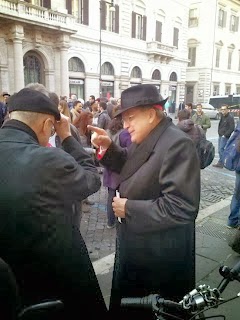 Cardinal Burke at a protest for gay marriage bill in Italy (Goes to show that love of the Liturgy is not opposed to public action, and love of the poor)
But it most certainly does not demand that we do this: Cardinal O'Malley at a protestant service (oops, I mean so called eccumenical gathering) receiving a blessing of some kind...Religious indifferentism....and he's apart of G8...Господи помилуй!

But it most certainly does not demand that we do this: Cardinal O'Malley at a protestant service (oops, I mean so called eccumenical gathering) receiving a blessing of some kind...Religious indifferentism....and he's apart of G8...Господи помилуй!
07 January 2014
Hoping in things of this world...
Is not a good idea. Temporal things well are temporary, they go away. Doesn't matter what they are, whether it's a job, marriage, research, whatever, these things are all temporary as in the sense that once one dies, they're gone.
Since it's the new year of course it is popular to make new years' resolutions. The reason people fail is not because of any bad intention, but they do not ask for the graces as to fulfill various tasks. That is to say on our own, we can't do anything, but with God's grace all things are possible.
While most certainly all things that we do are not dictate commands by the Holy Spirit (actually, I'd make an argument that the vast majority of things that we do are not commanded by the Holy Spirit)...we totally have free will....Certainly the Holy Spirit wants us to get to heaven.
By putting supernatural faith in things of this world, we make idols out of them, and as thus become material worshipers instead of worshipping the Trinity. We can put natural faith, as natural faith is necessary to function in society.....
But always remember, Faith in God first, Hope in the Holy Trinity, and God will never let you down.
Since it's the new year of course it is popular to make new years' resolutions. The reason people fail is not because of any bad intention, but they do not ask for the graces as to fulfill various tasks. That is to say on our own, we can't do anything, but with God's grace all things are possible.
While most certainly all things that we do are not dictate commands by the Holy Spirit (actually, I'd make an argument that the vast majority of things that we do are not commanded by the Holy Spirit)...we totally have free will....Certainly the Holy Spirit wants us to get to heaven.
By putting supernatural faith in things of this world, we make idols out of them, and as thus become material worshipers instead of worshipping the Trinity. We can put natural faith, as natural faith is necessary to function in society.....
But always remember, Faith in God first, Hope in the Holy Trinity, and God will never let you down.
11 December 2013
Evangelii Gaudium thoughts
With upcoming final exams, and my upcoming vacation...I realize that I'm not going to have the time to analyze every paragraph as I'd like, or perhaps I'll get back to it at a later date....but I'll summarize my thoughts in my own "exhortation form" ...modeled, but not the same as Christi Gaudium
Disclaimers:
1) Any resemblance to the real thing is merely a coincidence
2) It is not my fault that the real thing was too long.
Disclaimers:
1) Any resemblance to the real thing is merely a coincidence
2) It is not my fault that the real thing was too long.
NON-APOSTOLIC EXORTATION
GAUDIUM VERITATIS
OF A TEACHER ON EVANGELIZATION IN TODAY'S WORLD
The joy of Truth fills the hearts and minds of all who accept the Gospel, receive the Sacrament of Baptism and are bonded intimately to the Holy Church of God, the Mystical Body of Christ, the Holy Catholic Church.
The conditions of society are always in flux, but the mission of the Church is simple "Go therefore and make disciples of all nations, baptizing them in the Name of the Father, and of the Son and of the Holy Spirit, teaching them all that I have commanded of you" (cf Matt 28, 19-20)
The Gospel is to be preached to everyone, those that are in false religions (Islam, Judaism, etc), those who do not know religion (atheism, agnostics, etc). Everyone has a right to hear and know the Truth of the Catholic Church, absolutely no one is to be excluded.
A decentralized Church can't work unless the Bishops', the Pope included teach the Gospel of Jesus Christ, un-edited, without fear of offending people, or follow the Liturgical and Canonical laws of the Church. The Bishops' can't support specific policies on prudential judgement, and expect that the faithful listen to them when it counts on actual matters of Faith and morals. Since the Bishops' misuse what little authority they already have, the Holy See will not in any way delegate to local Bishops' conferences power on doctrine. Christ established Peter as the head of the Church (cf Matt 16, 18) ...and while how this headship has been exercised has varied over the centuries, It is Peter who is to confirm the faith of his brethren and take charge of matters in the Church (cf Jn 17)...Jesus did not give the other apostles' the keys and the successors of Peter have no power to change the words of Christ.
Any ministry must faithfully transmit the Catholic Faith, in its entirety, must firstly begin in the Worship of Almighty God, through the Church's Liturgy. The Liturgical Laws are to be strictly obeyed as to make the personality of the person disappear, and Christ truly present. The Liturgy is to be mysterious and covey heaven on earth. All banal songs are forbidden from Liturgy. In the Roman Church Gregorian chant is to be executed at all Masses. No longer will there be low Masses on Sundays, and Solemnities....God by the virtue of Justice is due supreme Worship, and so we will give unto Him what is rightly due. We will copy from our Eastern brethren the concept of singing the entire Liturgy. Going to Mass is meritorious in of itself, but our Love for God, needs to correspond to the love of neighbor.
The little traditions that we do to help us to remind us of Christ should be maintained, and fully explained as for future generations to deeply appreciate the fullness of the Catholic Faith.
The Church as founded by Christ Jesus is the Fullness of Truth, and is not merely one amongst many. As the Church founded by God himself, she has a right to proclaim the Truths of the Gospel, and call everyone to live out these Truths in daily society. She however loses credibility when she comes out in support of specific policy measures where the laity have more expertise than the pastors of these souls.
The responsibility of the hierarchy is to lead all souls to heaven. This can't be done when the Truths of the Church are half-preached, or ignored in their entirety. People will leave to go where the Truth is being taught because the Truth in of itself is attractive. This failure to preach the Truth of Christ wounds Christ as He desires everyone to be in union with His Bride the Catholic Church.
All of the problems in the world are due to the weakness of us not living our Faith to the fullness that we should. Whether it's abortion, sodomite marriage, or unemployment and hunger, all of these are due to the fact that Catholics do not live out their Faith correctly and to the fullest potential. Some points to consider in an economic situation
1) Any economic system requires moral people to run the system. Otherwise it will tend towards corruption because of original sin (or loss of grace)
2) It is a work of mercy to feed the poor. Christ does not say how this is best to be accomplished. If you figure a way that works, great.
3) Problems are best solved at the local level.
4) Abortion, sodomy can never be supported for any reason, period.
5) Everything that we have is a gift from God, and it is our duty out of our own free will to share this with others without coercion.
6) One can't give to others what one has rightfully earned.
With this in mind, the Church with Joy calls everyone unto herself through the sanctifying waters Baptism to participate in the Life of Grace with assistance through the gifts of the Holy Spirit...to teach the Truth to the ends of the earth, for all eternity Amen.
02 December 2013
Listening...or so it's called
Some people have made a point of telling (as well intended as they may be) me that God has something special planned for me. And in the context in these statements would be that somehow there are those that still consider me to have a vocation to the priesthood. (Apparently it must be something in how I act or something like that, I'm only giving to God what is due unto Him, it's really no big deal...seriously, it's not that big of a deal, and I think nothing of it)
And some have mentioned to me that I should consider a vocation in the Byzantine church (in a rather implicit way), that I'd make a good priest or what not.
In my own typical shyness, I brush things off, having walked down that road before, which of course the details of such are kept out of the public eye.
God most certainly provides the grace to get through any situation, provided we cooperate with it, and as I've often mentioned, I'm quite broken, and I don't just speak from my last experiences in living religious life, I speak of all my personal experiences and weaknesses (there are plenty)...I know that people really try to point out the good, but the reality is that I have plenty of weaknesses and blocks towards such a "vocation." I don't kid when I say I'm not the next coming of any of my favorite Saints.
I'm quite stubborn and refuse to bow to anyone other than God, (which works both for a good and bad thing)...I don't do the Gospel of political correctness (if you're offended, too darn bad)...I'm not a fan of the USCCB as a collective whole (although there are plenty of fine good individual Bishops), and I will call them out on their stupidity...(you know, supporting amnesty, Obamacare until there was abortion in it, etc.)....In my shyness, I'm quite a strong personality, I know these are my weaknesses...and they must change if I was to pursue a vocation to the priesthood again...
Yes, I am also very docile at times, sometimes too much so. Yes, I'm a firm believer if you're going to do something, then one must do so well. Surely I do sing the epistle at Divine Liturgy, but I do love God and so out of justice these things happen.
I definitely did think that if I was to become a priest, I would be bi-ritual doing both the Byzantine Liturgy and the Roman Liturgy. I've had a love for both forms of the Liturgy for quite a while now.
If it's in God's will that I become a priest it will happen, but for now, my life although not perfect by any means, I'm at peace with whatever God's will is. As always I do ask for your prayers, and thank you sincerely for compliments given...
Pax Vobis
And some have mentioned to me that I should consider a vocation in the Byzantine church (in a rather implicit way), that I'd make a good priest or what not.
In my own typical shyness, I brush things off, having walked down that road before, which of course the details of such are kept out of the public eye.
God most certainly provides the grace to get through any situation, provided we cooperate with it, and as I've often mentioned, I'm quite broken, and I don't just speak from my last experiences in living religious life, I speak of all my personal experiences and weaknesses (there are plenty)...I know that people really try to point out the good, but the reality is that I have plenty of weaknesses and blocks towards such a "vocation." I don't kid when I say I'm not the next coming of any of my favorite Saints.
I'm quite stubborn and refuse to bow to anyone other than God, (which works both for a good and bad thing)...I don't do the Gospel of political correctness (if you're offended, too darn bad)...I'm not a fan of the USCCB as a collective whole (although there are plenty of fine good individual Bishops), and I will call them out on their stupidity...(you know, supporting amnesty, Obamacare until there was abortion in it, etc.)....In my shyness, I'm quite a strong personality, I know these are my weaknesses...and they must change if I was to pursue a vocation to the priesthood again...
Yes, I am also very docile at times, sometimes too much so. Yes, I'm a firm believer if you're going to do something, then one must do so well. Surely I do sing the epistle at Divine Liturgy, but I do love God and so out of justice these things happen.
I definitely did think that if I was to become a priest, I would be bi-ritual doing both the Byzantine Liturgy and the Roman Liturgy. I've had a love for both forms of the Liturgy for quite a while now.
If it's in God's will that I become a priest it will happen, but for now, my life although not perfect by any means, I'm at peace with whatever God's will is. As always I do ask for your prayers, and thank you sincerely for compliments given...
Pax Vobis
01 December 2013
The Joy of the Gospel Paragraph's 6-10
Paragraph's 4 and 5 are pretty much Scripture quotes, so I'll not comment on those paragraph's, I'll move on to paragraph 6
There are Christians whose lives seem like Lent without Easter (Let's see what the Spanish says here "Hay cristianos cuya opción parece ser la de
una Cuaresma sin Pascua. Pero reconozco que la
alegría no se vive del mismo modo en todas las
etapas y circunstancias de la vida" The Spanish more literally says something like: There are Christians whose option seems to be a Lent without Easter. But I recognize that they joy would not live the same mode in all the stages and circumstances of the life....There are some people that are called to live their lives as penance for whatever reason, and we should not demean them for this...I think seem is trying to undercut the point that's being made in this part of the text)...The thing about joy is that it is not an emotional super high where everything's all perfect all the time...Joy is a state of being, a fruit of the Holy Spirit, but it doesn't mean emotional super high...That is to say, someone can seem down, and yet at the same time be joyous...Introverted personalities can probably understand where I'm coming from better) . I realize of course that joy is not expressed the same way at all times in life, especially at moments of great difficulty. Joy adapts and changes (I wouldn't say joy adapts or changes as God does not change, and if Joy is a fruit of the Holy Spirit, it's an aspect of God in us..rather, I'd say our joy is constant, but our expressions always change), but it always endures, even as a flicker of light born of our personal certainty that, when everything is said and done, we are infinitely loved. I understand the grief of people who have to endure great suffering (Some of us really endure it for His sake), yet slowly but surely we all have to let the joy of faith slow- ly revive as a quiet yet firm trust (Joy is constant, the expression, not so much), even amid the greatest distress: “My soul is bereft of peace; I have forgotten what happiness is... But this I call to mind, and therefore I have hope: the steadfast love of the Lord never ceases, his mercies nev- er come to an end; they are new every morning. Great is your faithfulness... It is good that one should wait quietly for the salvation of the Lord” (Lam 3:17, 21-23, 26). (Happiness is temporary, Joy is permanent)
There are Christians whose lives seem like Lent without Easter (Let's see what the Spanish says here "Hay cristianos cuya opción parece ser la de
una Cuaresma sin Pascua. Pero reconozco que la
alegría no se vive del mismo modo en todas las
etapas y circunstancias de la vida" The Spanish more literally says something like: There are Christians whose option seems to be a Lent without Easter. But I recognize that they joy would not live the same mode in all the stages and circumstances of the life....There are some people that are called to live their lives as penance for whatever reason, and we should not demean them for this...I think seem is trying to undercut the point that's being made in this part of the text)...The thing about joy is that it is not an emotional super high where everything's all perfect all the time...Joy is a state of being, a fruit of the Holy Spirit, but it doesn't mean emotional super high...That is to say, someone can seem down, and yet at the same time be joyous...Introverted personalities can probably understand where I'm coming from better) . I realize of course that joy is not expressed the same way at all times in life, especially at moments of great difficulty. Joy adapts and changes (I wouldn't say joy adapts or changes as God does not change, and if Joy is a fruit of the Holy Spirit, it's an aspect of God in us..rather, I'd say our joy is constant, but our expressions always change), but it always endures, even as a flicker of light born of our personal certainty that, when everything is said and done, we are infinitely loved. I understand the grief of people who have to endure great suffering (Some of us really endure it for His sake), yet slowly but surely we all have to let the joy of faith slow- ly revive as a quiet yet firm trust (Joy is constant, the expression, not so much), even amid the greatest distress: “My soul is bereft of peace; I have forgotten what happiness is... But this I call to mind, and therefore I have hope: the steadfast love of the Lord never ceases, his mercies nev- er come to an end; they are new every morning. Great is your faithfulness... It is good that one should wait quietly for the salvation of the Lord” (Lam 3:17, 21-23, 26). (Happiness is temporary, Joy is permanent)
7. Sometimes we are tempted to find excuses and complain, acting as if we could only be
happy if a thousand conditions were met (Well, again, happiness is temporary, joy is permanent). To some extent this is because our “technological
society has succeeded in multiplying occasions
of pleasure (or some would call this hedonism), yet has found it very difficult to engender joy (Well of course, because things of this world do not bring joy in the strict sense) ”.2 I can say that the most beautiful
and natural expressions of joy which I have seen
in my life were in poor people who had little to
hold on to (They are not bound to the gods of materialism). I also think of the real joy shown
by others who, even amid pressing professional
obligations, were able to preserve, in detachment
and simplicity, a heart full of faith. In their own
way, all these instances of joy flow from the infinite love of God, who has revealed himself to
us in Jesus Christ. I never tire of repeating those
words of Benedict XVI which take us to the very
heart of the Gospel: “Being a Christian is not the
result of an ethical choice or a lofty idea, but the
encounter with an event, a person, which gives
life a new horizon and a decisive direction” (Amen).3
8. Thanks solely to this encounter or renewed encounter – with God’s love, which blossoms into an enriching friendship, we are liberated from our narrowness and self-absorption (You can bet the temptations are there).
We become fully human when we become more
than human (Grace transforms us unto like Him, something that we can't do by ourselves), when we let God bring us beyond
ourselves in order to attain the fullest truth of
our being. Here we find the source and inspiration of all our efforts at evangelization. For if
we have received the love which restores mean-
8
ing to our lives, how can we fail to share that love with others? (Well, by our own selfishness wanting things for ourselves...Something that extroverts do not seem to get about those of us that are introverted, our natural tendency is to keep things interior...If people want to know something, by all means let them ask, but we're not going to go out and proclaim "I'm happier than you, nah nah nah, etc." )
life is attained and matures in the measure that it is offered up in order to give life to others. This is certainly what mission means (Well, literally mission means sent from the Latin...you might recognize Ite missa est :p)...doesn't necessarily giving life to others...per se)”.5 Consequently, an evangelizer must never look like someone who has just come back from a funeral! (But what if they actually did come back from a funeral and given the opportunity to evangelize...often the funeral Liturgy is a chance to evangelize lapsed Catholics)....LEt us look at the Spanish text again, and re-translate...Por consiguiente, un evangelizador no debería tener permanentemente cara de funeral....A better translation: For consequence, an evangelizer should not have permanently face of a funeral...Now this translation makes more sense...to say someone shouldn't have a face of a funeral, this is true, it would be difficult (not impossible) to reach someone with a depressed face)
Let us recover and deepen our enthusiasm, that “delightful and comforting joy of evangelizing, even when it is in tears that we must sow... And may the world of our time, which is searching, sometimes with anguish, sometimes with hope, be enabled to receive the good news not from evangelizers who are dejected, discouraged, impatient or anxious, but from ministers of the Gospel whose lives glow with fervour, who have first received the joy of Christ”.6 (More translation issues: Recobremos y acrecentemos el fervor, «la dulce y confortadora alegría de evangelizar, incluso cuando hay que sembrar entre lágrimas [...] Y ojalá el mundo actual —que busca a veces con angustia, a ve- ces con esperanza— pueda así recibir la Buena Nueva, no a través de evangelizadores tristes y desalentados, impacientes o ansiosos, sino a través de ministros del Evangelio, cuya vida irradia el fervor de quienes han recibido, ante todo en sí mismos, la alegría de Cristo ».6...Better translated: We recover and create the fervor..The sweet and comforting of to evangelize, including when there which to sow enter tears. And actually, the world actual, which looks to sometimes with anguish, sometimes with hope, can receive also the Good News not through evangelizers sad and desolate, or impatient, but through ministers of the Gospel, whose lives radiate the fervor who have received before all in themselves, the joy of Christ...The literal translation of these words tends to make me a bit more sense. That is to say, sure we should be joys and our lives should radiate such joy....but again, Joy is permanent, and not something that is expressed in an emotional super high...For sure there are cultural differences as to expressions, but the Roman way tends to be a bit more solemn and serious. The Byzantine way tends to be ornate with beauty....each must find their comfort zone....and work from it...While we're sometimes called to go outside of our comfort zones, God equips us with the grace to do what is necessary. )
More commentary tomorrow or within the coming days...this is a huge document which I'm trying to understand paragraph by paragraph, and as you can see, some of the nuances are lost in translation....seriously, the Vatican needs a better Spanish to English translator...I offer my services for much less than necessary (as long as I can get private Masses with the Emeritus daily :p))
-
2 Ibid. 8: AAS 67 (1975), 292.
-
3 Encyclical Letter Deus Caritas Est (25 December 2005),
8
ing to our lives, how can we fail to share that love with others? (Well, by our own selfishness wanting things for ourselves...Something that extroverts do not seem to get about those of us that are introverted, our natural tendency is to keep things interior...If people want to know something, by all means let them ask, but we're not going to go out and proclaim "I'm happier than you, nah nah nah, etc." )
II. The delightful And comforting joy of
evangelizing
9. Goodness always tends to spread. Every authentic experience of truth and goodness seeks by its very nature to grow within us, and any per- son who has experienced a profound liberation becomes more sensitive to the needs of others (Epic translation fail: Here's the Spanish: El bien siempre tiende a comunicarse. Toda
experiencia auténtica de verdad y de belleza busca
por sí misma su expansión, y cualquier persona
que viva una profunda liberación adquiere mayor
sensibilidad ante las necesidades de los demás... My translation: The good always tends to communicate itself. All experience authentic of truth and of beauty searches by itself its expansion and that any person that lives a profound liberation aquires greater sensibility before the necesities of the others....This is very much true, in the words of our dear Emeritus Pope "The Truth itself is attractive." We don't need to dress the Truth up in a fancy package, as all people sincerely desire the Truth...The 2nd half of the statement, that a person aquires greater sensibility before the necesitities of others...that is to say Love of God, should transform to love of neighbor, but serving God in of itself is good thing, though we should be attentive towards others). As it expands, goodness takes root and develops. If we wish to lead a dignified and fulfilling life, we have to reach out to others and seek their good (The Spanish text at this point says: Por eso, quien quiera vivir con dignidad y plenitud no tiene otro camino más que reconocer al otro y buscar su bien. My translation: Therefore, who wants to live with dignity and plentitud does not have other way more than to recognize the other and look for your good...To say though that good is dependent on recognition kind of to me seems a bit trivial....What if the other does not wish to be recognized? What if the other is happy where they are? Well, this most certainly doesn't mean we don't try to evangelize and teach them the Truth of the Faith, but..there are those that desire to be hidden...and for good reason...;). In this regard, several sayings of Saint Paul will not surprise us: “The love of Christ urges us on” (2 Cor 5:14); “Woe to me if I do not proclaim the Gospel” (1 Cor 9:16).
10. The Gospel offers us the chance to live life on a higher plane, but with no less intensity: (Another translation fail sponsored by the Vatican: The Spanish says: La propuesta es vivir en un nivel superior, pero no con menor intensidad, which is of course translated: The proposal is to live in a level superior, but not with less intensity...Honestly, who's translating this? Sigh, but I'll be perfectly honest, I have zero clue what's going on with this sentence...less intensity? Is there any place where the Gospel is being intensely lived? (I speak generally)...really?):
“Life grows by being given away, and it weakens in isolation and comfort. Indeed, those who enjoy life most are those who leave security on the shore and become excited by the mission of communicating life to others...(The Spanish text says: La vida se acrecienta dándola y se debilita en el aislamiento y la comodidad. De hecho, los que más disfrutan de la vida son los que dejan la seguridad de la orilla y se apasionan en la misión de comunicar vida a los demás...I'd translate it slightly differently...The giving life grows and is debilitated in isolation and the comfort, Of fact, they enjoy life more be those who leave the security of the shore and know passion in the mission of to communicate life to the others....But again, there are those that thrive in isolation...most introverts qualify under this...While certainly there are times of lonliness being in isolation, in general, those of us that look inward in our understanding of the universe...wouldn't agree with this statement...I barely get excited about speaking, let alone get excited about anything....)
”.4 When the Church summons Christians to take up the task of evangelization, she is simply pointing to the source of authentic personal fulfilment. For “here we discover a profound law of reality: that
4 fIfTh generAl conference of The lATIn AmerIcAn And cArIbbeAn bIshops, Aparecida Document, 29 June 2007, 360.
9. Goodness always tends to spread. Every authentic experience of truth and goodness seeks by its very nature to grow within us, and any per- son who has experienced a profound liberation becomes more sensitive to the needs of others (Epic translation fail: Here's the Spanish: El bien siempre tiende a comunicarse. Toda
experiencia auténtica de verdad y de belleza busca
por sí misma su expansión, y cualquier persona
que viva una profunda liberación adquiere mayor
sensibilidad ante las necesidades de los demás... My translation: The good always tends to communicate itself. All experience authentic of truth and of beauty searches by itself its expansion and that any person that lives a profound liberation aquires greater sensibility before the necesities of the others....This is very much true, in the words of our dear Emeritus Pope "The Truth itself is attractive." We don't need to dress the Truth up in a fancy package, as all people sincerely desire the Truth...The 2nd half of the statement, that a person aquires greater sensibility before the necesitities of others...that is to say Love of God, should transform to love of neighbor, but serving God in of itself is good thing, though we should be attentive towards others). As it expands, goodness takes root and develops. If we wish to lead a dignified and fulfilling life, we have to reach out to others and seek their good (The Spanish text at this point says: Por eso, quien quiera vivir con dignidad y plenitud no tiene otro camino más que reconocer al otro y buscar su bien. My translation: Therefore, who wants to live with dignity and plentitud does not have other way more than to recognize the other and look for your good...To say though that good is dependent on recognition kind of to me seems a bit trivial....What if the other does not wish to be recognized? What if the other is happy where they are? Well, this most certainly doesn't mean we don't try to evangelize and teach them the Truth of the Faith, but..there are those that desire to be hidden...and for good reason...;). In this regard, several sayings of Saint Paul will not surprise us: “The love of Christ urges us on” (2 Cor 5:14); “Woe to me if I do not proclaim the Gospel” (1 Cor 9:16).
10. The Gospel offers us the chance to live life on a higher plane, but with no less intensity: (Another translation fail sponsored by the Vatican: The Spanish says: La propuesta es vivir en un nivel superior, pero no con menor intensidad, which is of course translated: The proposal is to live in a level superior, but not with less intensity...Honestly, who's translating this? Sigh, but I'll be perfectly honest, I have zero clue what's going on with this sentence...less intensity? Is there any place where the Gospel is being intensely lived? (I speak generally)...really?):
“Life grows by being given away, and it weakens in isolation and comfort. Indeed, those who enjoy life most are those who leave security on the shore and become excited by the mission of communicating life to others...(The Spanish text says: La vida se acrecienta dándola y se debilita en el aislamiento y la comodidad. De hecho, los que más disfrutan de la vida son los que dejan la seguridad de la orilla y se apasionan en la misión de comunicar vida a los demás...I'd translate it slightly differently...The giving life grows and is debilitated in isolation and the comfort, Of fact, they enjoy life more be those who leave the security of the shore and know passion in the mission of to communicate life to the others....But again, there are those that thrive in isolation...most introverts qualify under this...While certainly there are times of lonliness being in isolation, in general, those of us that look inward in our understanding of the universe...wouldn't agree with this statement...I barely get excited about speaking, let alone get excited about anything....)
”.4 When the Church summons Christians to take up the task of evangelization, she is simply pointing to the source of authentic personal fulfilment. For “here we discover a profound law of reality: that
4 fIfTh generAl conference of The lATIn AmerIcAn And cArIbbeAn bIshops, Aparecida Document, 29 June 2007, 360.
9
life is attained and matures in the measure that it is offered up in order to give life to others. This is certainly what mission means (Well, literally mission means sent from the Latin...you might recognize Ite missa est :p)...doesn't necessarily giving life to others...per se)”.5 Consequently, an evangelizer must never look like someone who has just come back from a funeral! (But what if they actually did come back from a funeral and given the opportunity to evangelize...often the funeral Liturgy is a chance to evangelize lapsed Catholics)....LEt us look at the Spanish text again, and re-translate...Por consiguiente, un evangelizador no debería tener permanentemente cara de funeral....A better translation: For consequence, an evangelizer should not have permanently face of a funeral...Now this translation makes more sense...to say someone shouldn't have a face of a funeral, this is true, it would be difficult (not impossible) to reach someone with a depressed face)
Let us recover and deepen our enthusiasm, that “delightful and comforting joy of evangelizing, even when it is in tears that we must sow... And may the world of our time, which is searching, sometimes with anguish, sometimes with hope, be enabled to receive the good news not from evangelizers who are dejected, discouraged, impatient or anxious, but from ministers of the Gospel whose lives glow with fervour, who have first received the joy of Christ”.6 (More translation issues: Recobremos y acrecentemos el fervor, «la dulce y confortadora alegría de evangelizar, incluso cuando hay que sembrar entre lágrimas [...] Y ojalá el mundo actual —que busca a veces con angustia, a ve- ces con esperanza— pueda así recibir la Buena Nueva, no a través de evangelizadores tristes y desalentados, impacientes o ansiosos, sino a través de ministros del Evangelio, cuya vida irradia el fervor de quienes han recibido, ante todo en sí mismos, la alegría de Cristo ».6...Better translated: We recover and create the fervor..The sweet and comforting of to evangelize, including when there which to sow enter tears. And actually, the world actual, which looks to sometimes with anguish, sometimes with hope, can receive also the Good News not through evangelizers sad and desolate, or impatient, but through ministers of the Gospel, whose lives radiate the fervor who have received before all in themselves, the joy of Christ...The literal translation of these words tends to make me a bit more sense. That is to say, sure we should be joys and our lives should radiate such joy....but again, Joy is permanent, and not something that is expressed in an emotional super high...For sure there are cultural differences as to expressions, but the Roman way tends to be a bit more solemn and serious. The Byzantine way tends to be ornate with beauty....each must find their comfort zone....and work from it...While we're sometimes called to go outside of our comfort zones, God equips us with the grace to do what is necessary. )
More commentary tomorrow or within the coming days...this is a huge document which I'm trying to understand paragraph by paragraph, and as you can see, some of the nuances are lost in translation....seriously, the Vatican needs a better Spanish to English translator...I offer my services for much less than necessary (as long as I can get private Masses with the Emeritus daily :p))
The Joy of the Gospel Pargaphs 1-3
The Holy Father has a new exortation....here it is: I'm going to analyze it chapter by chapter. Apparently, the Vatican has no idea how to translate Spanish correctly, so I'm going to go ahead and translate the Spanish where necessary, my comments are in red
Paragraphs 4-7 will come later on :)...There's a lot to digest here, so be patient, Pax Vobis
1. The joy of The gospel fills the hearts and
lives of all who encounter Jesus (Bear in mind that joy is one of the fruits of the Holy Spirit, but that does not mean that all is an emotional super high either). Those who accept his offer of salvation are set free from sin,
sorrow, inner emptiness and loneliness (Salvation is the final act, when we die..., indeed we are set free, but this doesn't mean that there won't be temptations of this sort). With
Christ joy is constantly born anew. In this Exhortation I wish to encourage the Christian faithful to embark upon a new chapter of evangelization marked by this joy (oh boy), while pointing out new
paths for the Church’s journey in years to come (Let's give him a chance).
I. A joy ever new, A joy whIch Is shared
2. The great danger in today’s world, pervaded as it is by consumerism, is the desolation and anguish born of a complacent yet covetous heart, the feverish pursuit of frivolous pleasures, and a blunted conscience (Indeed so). Whenever our interior life becomes caught up in its own interests and concerns, there is no longer room for others, no place for the poor (Well, I don't know if I fully agree with that statement, perhaps it could be better to say that our priorities are screwed when we put ourselves first, we should be last...God, others, ourselves). God’s voice is no longer heard (maybe God's voice is ignored might be better, I wouldn't necessarily say that God's voice isn't heard...), the quiet joy of his love is no longer felt, and the desire to do good fades (Possibly, in some cases because people wish to boost their own egos, they'll try to do more good, this is of course a wrong attitude as to why to do good things, we do good things for our Love of God, and love of neighbor ). This is a very real danger for believers too. Many fall prey to it, and end up resentful, angry and listless. That is no way to live a dignified and fulfilled life; it is not God’s will for us, nor is it the life in the Spirit which has its source in the heart of the risen Christ.
resurrection of Jesus, let us never give up, come what will. May nothing inspire more than his life, which impels us onwards!
I. A joy ever new, A joy whIch Is shared
2. The great danger in today’s world, pervaded as it is by consumerism, is the desolation and anguish born of a complacent yet covetous heart, the feverish pursuit of frivolous pleasures, and a blunted conscience (Indeed so). Whenever our interior life becomes caught up in its own interests and concerns, there is no longer room for others, no place for the poor (Well, I don't know if I fully agree with that statement, perhaps it could be better to say that our priorities are screwed when we put ourselves first, we should be last...God, others, ourselves). God’s voice is no longer heard (maybe God's voice is ignored might be better, I wouldn't necessarily say that God's voice isn't heard...), the quiet joy of his love is no longer felt, and the desire to do good fades (Possibly, in some cases because people wish to boost their own egos, they'll try to do more good, this is of course a wrong attitude as to why to do good things, we do good things for our Love of God, and love of neighbor ). This is a very real danger for believers too. Many fall prey to it, and end up resentful, angry and listless. That is no way to live a dignified and fulfilled life; it is not God’s will for us, nor is it the life in the Spirit which has its source in the heart of the risen Christ.
3. I invite all Christians, everywhere, at this very
moment, to a renewed personal encounter with
Jesus Christ ( There can be a danger in basing one's relationship with God based upon an emotional encounter. That is to say to encounter God, does not necessarily mean that there will be an emotion of consolation attached to it...We are certainly called to a deep intimacy with God, but this again doesn't mean there will be emotions to console or confirm this...traditional Catholic theology has avoided this term in the past as to not confuse or to equate emotions in a relationship with God...this mixing of emotions and relationship is commonly called phenomenology) , or at least an openness to letting Him (capitalization fail) encounter them; I ask all of you to do this
unfailingly each day. No one should think that
this invitation is not meant for him or her, since
“no one is excluded from the joy brought by the
Lord”.1 The Lord does not disappoint those who
take this risk (Of course, but we as humans are weak, hence why our relationships should not be based upon the fragile thing known as emotion); whenever we take a step towards
Jesus, we come to realize that He is already there (I don't know about that part),
waiting for us with open arms (God is a loving Father always waiting to embrace us when we return to Him). Now is the time to
say to Jesus: “Lord, I have let myself be deceived;
in a thousand ways I have shunned your love, yet
here I am once more, to renew my covenant with
you. I need you. Save me once again , Lord, take
me once more into your redeeming embrace”.
How good it feels to come back to him whenever we are lost! (The prayer says something slightly different: here is the spanish: Señor, me he dejado engañar, de mil
maneras escapé de tu amor, pero aquí estoy otra
vez para renovar mi alianza contigo. Te necesito.
Rescátame de nuevo, Señor, acéptame una vez
más entre tus brazos redentores: The translation that concerns me here is Rescatame de neuvo...is translated as save me once again...it'd be better to translate this as redeem me once again...strictly speaking Salvation is considered our final act whether we're in heaven or in hell...for our time on earth, redemption would be a better word to apply here...Protestants often speak of "being saved." One can't be "saved" unless one is dead ;)...) Let me say this once more: God never tires of forgiving us; we are the ones who tire of seeking his mercy (How true this is, how hard is it to go to Confession where Christ forgives us through the person of the priest? It's embarrassing, difficult, painful...I don't know about you, but I often struggle to go to the box, even though I make myself go) . Christ, who told us to forgive one another “seventy times seven” (Mt 18:22) has given us his example: he has forgiven us seventy times seven. Time and time again he bears us on his shoulders (Christ never stops forgiving us, as long as we keep trying, we need to persevere until the end of the race). No one can strip us of the dignity bestowed upon us by this boundless and unfailing love. With a tenderness which never disappoints, but is always capable of restoring our joy, he makes it possible for us to lift up our heads and to start anew. Let us not flee from the
1 pAul VI, Apostolic Exhortation Gaudete in Domino (9 May 1975), 22: AAS 67 (1975), 297.
maneras escapé de tu amor, pero aquí estoy otra
vez para renovar mi alianza contigo. Te necesito.
Rescátame de nuevo, Señor, acéptame una vez
más entre tus brazos redentores: The translation that concerns me here is Rescatame de neuvo...is translated as save me once again...it'd be better to translate this as redeem me once again...strictly speaking Salvation is considered our final act whether we're in heaven or in hell...for our time on earth, redemption would be a better word to apply here...Protestants often speak of "being saved." One can't be "saved" unless one is dead ;)...) Let me say this once more: God never tires of forgiving us; we are the ones who tire of seeking his mercy (How true this is, how hard is it to go to Confession where Christ forgives us through the person of the priest? It's embarrassing, difficult, painful...I don't know about you, but I often struggle to go to the box, even though I make myself go) . Christ, who told us to forgive one another “seventy times seven” (Mt 18:22) has given us his example: he has forgiven us seventy times seven. Time and time again he bears us on his shoulders (Christ never stops forgiving us, as long as we keep trying, we need to persevere until the end of the race). No one can strip us of the dignity bestowed upon us by this boundless and unfailing love. With a tenderness which never disappoints, but is always capable of restoring our joy, he makes it possible for us to lift up our heads and to start anew. Let us not flee from the
1 pAul VI, Apostolic Exhortation Gaudete in Domino (9 May 1975), 22: AAS 67 (1975), 297.
resurrection of Jesus, let us never give up, come what will. May nothing inspire more than his life, which impels us onwards!
Paragraphs 4-7 will come later on :)...There's a lot to digest here, so be patient, Pax Vobis
Subscribe to:
Posts (Atom)